












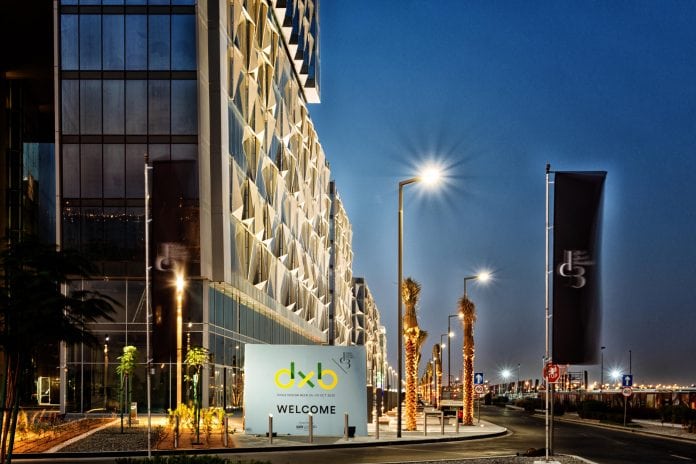
Downtown Design sells the tickets, but the outdoor programme at d3 holds the festival’s more interesting ideas.
A place to visit this week is Dubai Design District, where the 12th edition of Dubai Design Week runs until 8 November. The festival opened yesterday and is open to the general public. Downtown Design, the fair at its centre, opens today. Tickets cost AED 80 for one day or AED 150 for all four public days, according to Emirates 24|7. Le Petit Journal lists public entry from 5 November.
You should start outdoors. We base this view on the published programme, because the strongest ideas on paper come from old materials and everyday habits.
Nao Architects won this year’s Urban Commissions competition with Three Gardens and a Room. Reem Nassour founded the Dubai practice. Her design arranges vegetation, colour, shade and filtered light into three gardens around a shared central space. Shade and planting decide whether anyone stays outdoors in this city, so the brief has a practical edge.
Four more installations deserve your time. Rasha Saffarini’s Taqleem builds a communal space from the Emirati practice of palm tree trimming. In InBetween What Was and What Will Be, aestudio turns reclaimed concrete rubble into new architectural forms. Nikken Sekkei, the firm behind One Za’abeel, returns with Sobokuya to present Chatai 2.0. This expanded timber structure takes the form of an engawa, the traditional Japanese veranda. Alter’s Playing Field turns Ludo into a full-scale game made from handmade recycled cement tiles.
Abwab, the festival’s commissioning programme, has changed format. It has moved from individual pavilions to a single group exhibition called In Other Words. The show looks at how people communicate through gestures, signs, symbols and oral histories. Kanaka Raghavan’s Cheent Devanagari, for example, layers translucent textiles with Devanagari lettering.
If you collect jewellery, see the L’École exhibition. The school, with support from Van Cleef & Arpels, recreates a Celtic gold torque from the Second Iron Age, a period running from 450 to 25 BCE. You see how goldsmiths worked, which tells you more about an object than a brand presentation can.
The UAE Designer Exhibition returns under the theme Inherited Futures, with architect AlZaina Lootah as design collaborator. It asks how inherited materials, rituals and technologies can shape current design.
The fair earns its ticket if you are furnishing a home or commissioning a project. Its last edition showed more than 300 brands, by the organiser’s count. This year’s names include Venini, Gaggenau and Ethimo. Buccellati returns for a second year with Aquae Mirabiles, a presentation of its Caviar silverware with watercolours by Luke Edward Hall.
Spend most of your fair time on the regional work. Iwan Maktabi presents new carpets and textiles by Nadine Kanso, who draws on Arabic calligraphy, and Omar Al Gurg, who draws on memories of the traditional majlis. The 2026 Athath Fellowship cohort shows furniture prototypes developed for the market, so you see these pieces before they reach a showroom. A separate exhibition revisits Memphis Milano, the movement Ettore Sottsass launched in 1981.
The outdoor Marketplace runs on 7 and 8 November, with independent makers selling homeware, jewellery and fashion. Food, children’s activities and live performances share the site, so choose the weekend for browsing and not for a close look at the architecture.
Le Petit Journal lists festival hours as 10am to 10pm. See the installations on a weekday evening, then decide whether the fair deserves your AED 80.