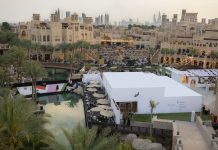









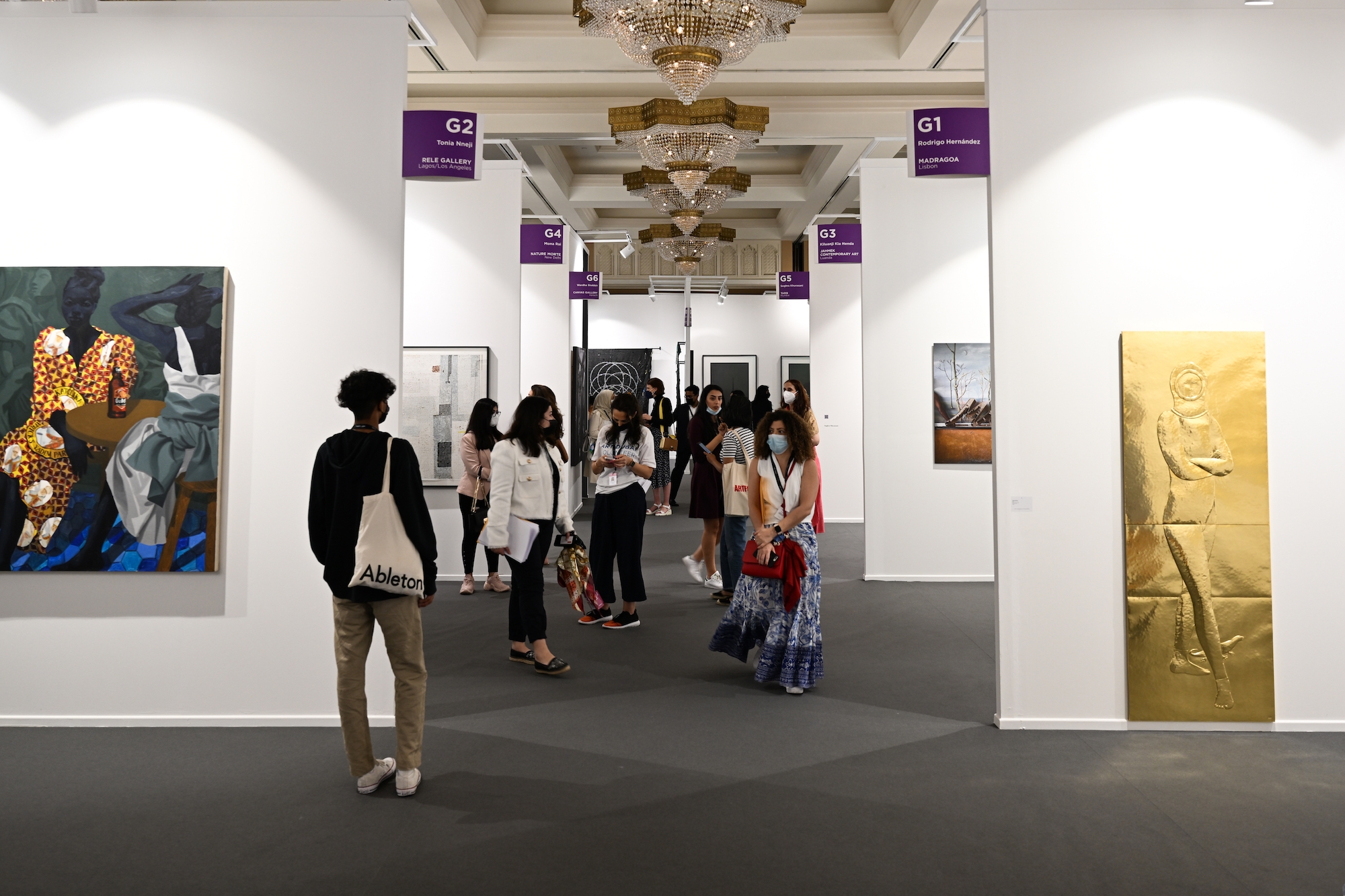
Art Dubai 2026 opens to the public tomorrow at Madinat Jumeirah, and the first thing you notice is not a painting. It is the architecture wrapping the work.
Rashid and Ahmed Bin Shabib have reconstructed their Manameh Pavilion, first shown for Bahrain at the 2025 Venice Architecture Biennale. The structure draws on the manameh, an elevated platform built across the Gulf for shade and cross ventilation, with woven palm and timber holding cool air below. In Dubai the pavilion sits as both shelter and lecture hall, hosting Huna Talks and Dubai Collection sessions across three days. You sit inside an argument about heat, sustainability, and how the region built before air conditioning arrived. It reads as a quiet rebuke of every glass tower outside the resort gates.
Across the venue, Hashel Al Lamki installs Maat with Tabari Artspace. The material list is the eye catcher. Burial cloth and bridal cloth, restitched into one surface by artisans in Mallorca, Kerala, and Cairo. Two thresholds of one life held together. Al Lamki is Emirati. He studied at Parsons in New York and at Abu Dhabi University. The piece treats textile as memory rather than decoration. Collectors stop, then ask where the fabrics came from. The answer matters.
 The Ministry of Culture has placed When the Familiar Becomes Unfamiliar in a dedicated section. Three Emirati women, all of them funded through Ministry grants. Karima Al Shomely takes Emirati textile traditions, the burqa and sadu weaving among them, and casts them as sculptural form. The fabric stops being garment and becomes structure.
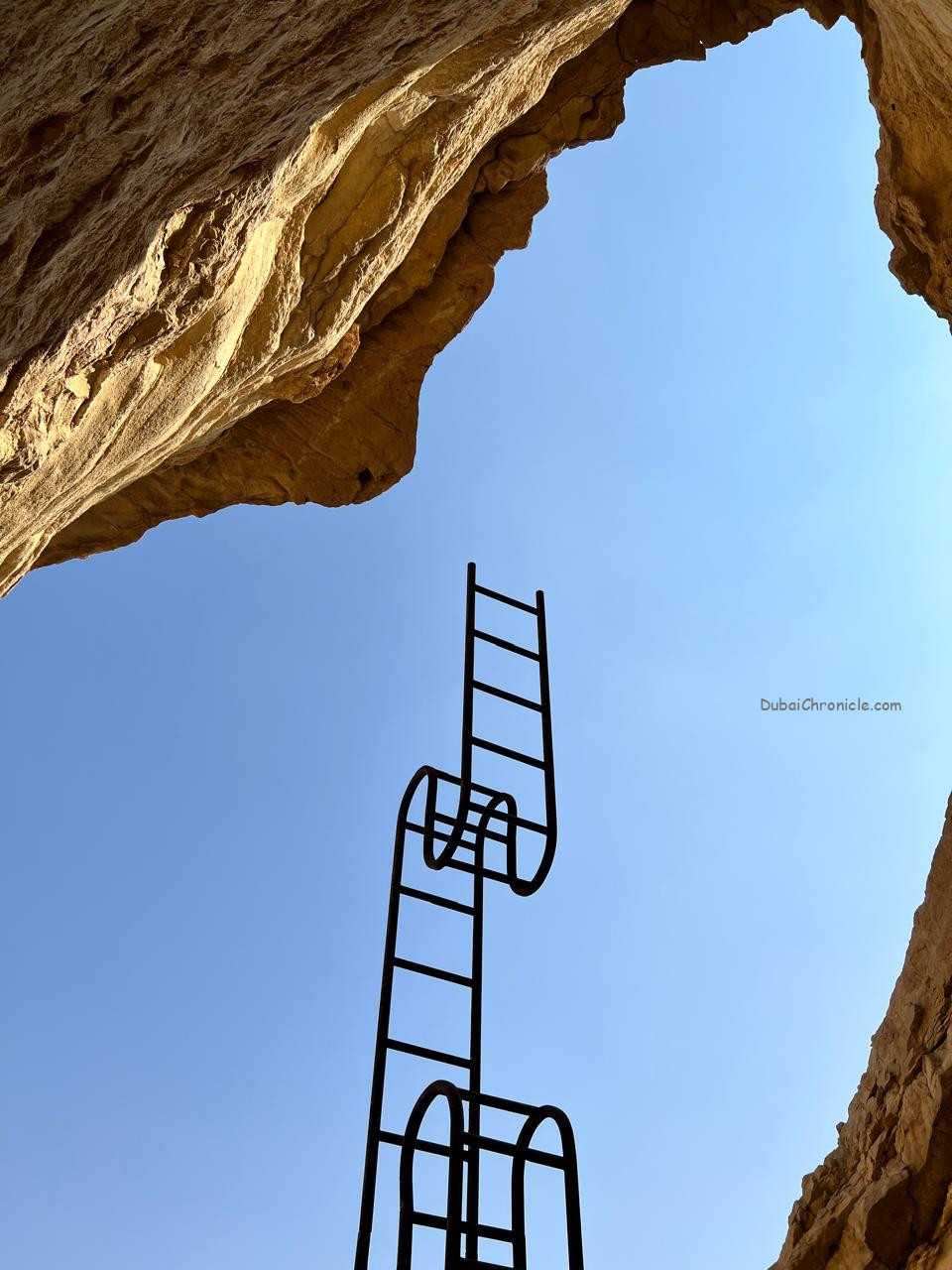 Rawdha Al Ketbi works with ladders and other household objects, pulling them into compositions about balance and elevation. Sara Ahli works in blown and cast glass, with body forms held in fluid silhouette. Mubarak Al Nakhi, Undersecretary at the Ministry, framed the exhibition around contemporary practice holding cultural specificity rather than dissolving into international style. The work supports the claim. None of it reads as borrowed.
Khalid Al Banna’s The Path, with House of Arts, presents two large surfaces. Al Banna is an Emirati abstractionist working in collage and mixed media, with provenance from Sharjah Biennials going back twenty years. The colour fields read close to Hans Hofmann from a distance, then shift on approach into layered paper, fabric scraps, and printed text in Arabic. Worth standing close.
On collecting, the Dubai Collection installs Made Forward, its institutional record of acquisitions across two decades. The Barjeel Art Foundation, Sultan Sooud Al Qassemi’s collection, hangs modern Arab masters from the 1950s through the 1970s. Etel Adnan, Inji Efflatoun, Saloua Raouda Choucair. If you collect in the region, this is the room to memorise. Secondary market prices for these names have moved hard in the past eighteen months. The Barjeel hang tells you why.
On retail, the pop up store at the venue runs UAE designers across fashion, ceramics, and small editions. Thirty minutes well spent. Fashion is otherwise light this edition, with the strongest signal coming from the dressed crowd rather than vendors. Expect Hussein Bazaza on shoulders, Madiyah Al Sharqi tailoring, and resale Bouchra Jarrar arriving on collectors at the preview.
Dining runs through the existing Madinat restaurants. Folly by Nick and Scott and Pierchic absorb the after fair traffic. The Bahri Bar at Mina A’Salam holds the conversation through the evening. If you came to listen, sit there.
One paragraph of context worth carrying with you. Galleries paid no fixed booth fee this edition. They pay a percentage of sales, capped at the standard fee. Around fifty galleries showed up. Roughly seventy five planned to and pulled out after the April postponement following the US Israel war in Iran. What hangs on the walls is what survived a logistics test and a financial restructure. Read the room with the filter on.