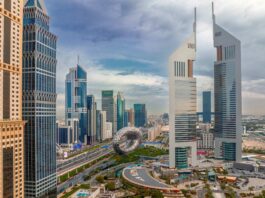



Dubai and Abu Dhabi both rank inside the global top 10 of the Savills Next Generation Wealth Hubs Index, published this week, as two international forums in Dubai described global capital as available but increasingly selective about where it goes.
Between 13 and 15 October, the World Economic Forum and the UAE Government held the inaugural Annual Meeting of Global Future Leaders in Dubai. On 14 October, RISE Summit 2026 brought global investors to Dubai World Trade Centre. Read alongside the wealth index, both meetings point to one shift: a younger generation of wealth holders, a more cautious institutional investor, and a city positioning itself for both.
Where next-generation wealth settles
The index scored more than 100 destinations on their ability to attract and retain high-net-worth individuals under 40 who recently made or inherited their wealth. It measures four areas: business, governance and connectivity, wealth clusters and local environment, wealth management and taxation, and lifestyle.

New York leads, followed by Miami, London, San Francisco and Los Angeles. Singapore places sixth. Both UAE cities fall between seventh and tenth place. The report does not state their exact positions, and Dubai Chronicle has not independently verified them. Only four EMEA locations reach the top 10, and Dubai and Abu Dhabi hold two of those places alongside London. Across the top 30, EMEA markets take 16 spots.
The scale of wealth in motion explains the attention. The report estimates US$84 trillion will pass between generations over the next two decades. The figure is a projection, not an audited total. Its authors link the younger cohort’s choices to lifestyle, education, wellness and personal values alongside tax. For Dubai, the report cites its entrepreneurial base, its global connectivity, and the highest count of top-tier sporting events among the locations analysed, a position it shares with London. Rachael Kennerley, director of research for the Middle East, points to succession planning across the GCC, with families paying closer attention to governance, next-generation involvement and the deployment of capital inside the region.
Capital grows selective
The summit, with more than 500 delegates in the room, carried a more cautious institutional view. José Manuel Barroso, chairman of international advisors at Goldman Sachs, said global investors will reduce heavy exposure to the United States and diversify across geographies and sectors. He described the Gulf as a connecting point between new investment destinations, and named energy, infrastructure, technology and defence as the sectors set to reshape markets.
Ludovic Subran, group chief investment officer and chief economist at Allianz, said global trade sits in recession this year once AI spending drops out of the count, a measure of how far data-centre capital expenditure now carries growth. Outside AI, he said, companies remain cautious about their next investment. He also described real estate and infrastructure converging, particularly in logistics and warehousing.
Organisers summarised the day’s discussions around four factors now shaping investment decisions: economic resilience, infrastructure capacity, regulatory clarity and access to long-term growth.
Issam Kazim, CEO of Dubai Corporation for Tourism and Commerce Marketing, said around 25 percent of Dubai visitors return within 12 months. No historical or peer comparison accompanies the figure, and Dubai Chronicle has not independently verified it. He described the D33 agenda as building on logistics, manufacturing, financial services and tourism, sectors where Dubai already held strength, and said companies place regional headquarters in Dubai for the markets they reach from the city rather than for its four million residents. Abdulla bin Touq Al Marri, UAE Minister of Economy and Tourism, told the summit the country will enter 2027 with a different and more productive economy.
The leadership question
The Forum’s meeting gathered more than 500 participants, including 15 ministers and nearly 150 CEOs and chairs, alongside members of its Young Global Leaders community. The programme covered agentic AI, trade, and economics after certainty, and launched Future20, a group of 20 next-generation leaders. New research scheduled for release during the meeting includes a Middle East and North Africa analysis of AI for sustainable development and data-centre infrastructure optimisation. Dubai Chronicle had not reviewed this research at the time of writing.
Data centres link all three sources. Subran treats AI capital expenditure as the current engine of global growth. The Forum commissioned regional research on data-centre infrastructure. The wealth index describes a younger cohort ranking connectivity and mobility among first priorities.
The residential angle
The report ties these shifting priorities to rising demand for branded residences, wellness-led developments and turnkey homes for globally mobile buyers who divide time across jurisdictions. It presents this as an observed trend and publishes no transaction volumes to quantify it.