
Ask someone where they’d move for a better life and they’ll name a city. Ask an economist the same question and you’ll get a country. Ask three research groups that spent 2026 measuring exactly this, and you get an answer more useful than either: the best places to prosper aren’t always the best places to live, and the two rarely show up on the same list for the same reasons.
That gap is where this year’s data gets interesting. The IMF tracks where money grows. The Economist Intelligence Unit tracks where cities function. Global Citizen Solutions tracks where people who actually move, digital nomads, retirees, relocating families, choose to land. None of them set out to answer “where can I build a life and build wealth at once.” Put side by side, they answer it anyway, and the UAE sits at the center of that answer in a way its own headlines haven’t quite caught up to.
Start with the growth numbers, because they’re the least ambiguous. The IMF’s April 2026 World Economic Outlook cut global growth to 3.1 percent, a direct consequence of the Middle East war and the closure of the Strait of Hormuz. The UAE took a cut too, down to 3.1 percent from 5.8 percent the year before. On its own, that reads like bad news. Next to its neighbors, it reads like the opposite. Three of the five worst-performing economies in the IMF’s entire 197-country dataset sit right next door: Qatar contracting 8.6 percent, Iraq contracting 6.8 percent, Iran contracting 6.1 percent. The UAE weathered the same shock and landed exactly at the global average, a spot none of its neighbors came close to holding.
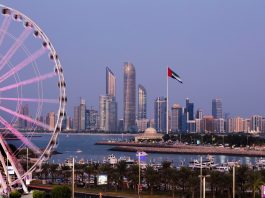
The EIU’s liveability index, published the same week in July, tells a version of the same story from ground level. Its 173-city index recorded the steepest regional decline anywhere in the world in the Middle East and North Africa, the average score sliding to 61.2. But not every Gulf city took the same hit. Muscat fell 14 places after Iranian drone strikes, the single biggest drop anywhere in the index. Kuwait City fell 12. Doha fell seven. Dubai and Abu Dhabi each fell four, the smallest movement of any Gulf city named in this year’s coverage. Line that up against the IMF numbers and the pattern holds almost exactly. Wherever the war did the most economic damage, it did the most liveability damage too, and the UAE’s two biggest cities came through both measures with the least to show for it.
Then there’s the layer that actually speaks to the person doing the moving, not just the economy absorbing the shock. Global Citizen Solutions built its 2026 index specifically around relocation decisions, and Dubai posted the highest safety score of any city in its 35-city sample. It still ranked 19th overall. The reason is almost mechanical: cities that dominate one category rarely dominate the composite, because whatever makes them exceptional at one thing tends to cost them somewhere else. For Dubai, that cost shows up in air quality and in English proficiency scores that trail the cities above it. Abu Dhabi wasn’t part of this particular sample, so there’s no equivalent number to hold up against Dubai’s here, and it would be a mistake to guess at one.
Read together, these three data sets don’t converge on a single ranking. They converge on a distinction worth making before anyone acts on either headline. If prosperity means where capital is safest and growing fastest under real regional pressure, the UAE’s case this year is about as strong as it gets against any Gulf peer, and both the IMF and the EIU back that up independently. If prosperity means the daily experience of living somewhere, benchmarked against Lisbon or Amsterdam rather than against Doha, Dubai’s own numbers show a genuine strength in safety next to two real constraints. Neither fact cancels the other. A place can be the most resilient in its region and still sit outside the top half of a global liveability list, because resilience and liveability are answering different questions, and the mistake isn’t in either number, it’s in treating them as one.
For anyone using this year’s rankings to make an actual decision, capital allocation on one hand, relocation on the other, the useful move is keeping the two questions apart rather than collapsing them into a single verdict on “the best places to prosper.” The UAE’s growth case this year is as clean as any in the Gulf. Its liveability case is real, strongest on safety, weaker on air and language, and incomplete for Abu Dhabi until a comparable index actually covers it. Knowing which question you’re answering matters more than the ranking itself.