
Monthly rent in Dubai lowers the entry cost of a home, but it moves risk onto whoever carries the payment schedule. Landlords collecting instalments directly take on more exposure to unpaid rent. Tenants paying through a financing provider take on fees and repayment pressure. Before you agree to monthly payments, understand what each arrangement leaves you holding.
Three routes to monthly rent in Dubai exist. A landlord can agree to collect rent directly in twelve instalments, by postdated cheques or bank transfer. Dubai Land Department’s Flexi Rent initiative, launched in June 2026, lets tenants pay monthly, quarterly or semiannually through participating property management companies. A private financing provider can pay the landlord upfront and collect monthly repayments from the tenant, for a fee. The risks differ across these routes, so judge each on its own terms.
A monthly schedule does not create a monthly tenancy. Under Law No. 26 of 2007, neither party can end a valid lease alone, except by mutual consent or under the law’s own provisions. You remain bound for the full term.
The appeal lies in the smaller first payment. At AED 120,000 a year, a single cheque requires AED 120,000 on day one. Monthly instalments cut this to AED 10,000. For a landlord facing a vacancy, monthly terms can attract applicants faster.


For landlords collecting monthly rent in Dubai directly, the main risk sits in the instalments not yet due. If a tenant stops paying or leaves the country, those months may never arrive. You face interrupted income, recovery proceedings, delays in regaining possession, repair costs and a fresh vacancy. Service charges and mortgage payments continue regardless.
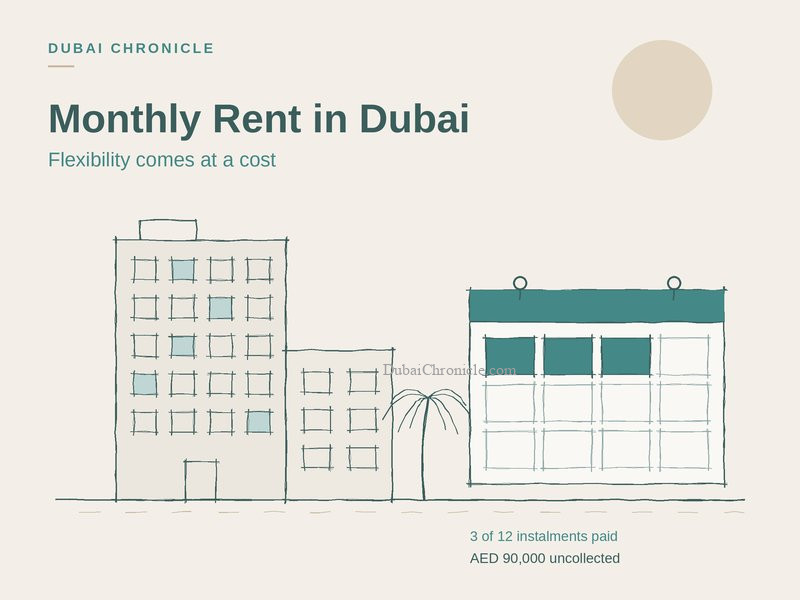
Consider a home let at AED 120,000 a year in monthly instalments of AED 10,000. The tenant pays three and stops. AED 90,000 of scheduled annual rent remains uncollected. This figure describes scheduled unpaid rent, not a final loss or an amount a tribunal will award. It shows how much of the year depends on the tenant’s continued ability and willingness to pay.
Collecting more in advance reduces this exposure. With quarterly payments, a default inside a paid quarter leaves those weeks covered. Cleared annual rent covers the whole term. Neither removes all risk. A postdated cheque can bounce, and money in hand does not prevent damage or disputes.
Do not rely on the security deposit. Article 20 of Law No. 26 of 2007 lets a landlord take a deposit to ensure maintenance of the property at the end of the lease. Even a 10 per cent deposit on AED 120,000 equals AED 12,000, against AED 90,000 of unpaid scheduled rent in the example above.
Do not expect fast recovery. Under Article 25 of Law No. 26 of 2007, as amended by Law No. 33 of 2008, a landlord may seek eviction before expiry if the tenant fails to pay within 30 days of a notice the landlord serves through a notary public or by registered mail. A tenant who pays inside the window keeps the lease. Disputes go to the Rental Dispute Settlement Centre, and a ruling in your favour does not guarantee collection.
If you consider monthly collection, screen the tenant first. Check payment history, employer, length of service and the ratio of rent to salary. Set clear terms on due dates, payment method and returned cheques. Confirm your reserves can carry several missed months alongside service charges and mortgage payments.
A provider paying you upfront changes your exposure only as far as its contract allows. Before signing, confirm when funds reach you, what the provider deducts, whether it guarantees payment on default and who pursues the tenant. Staged payouts or clawback rights leave part of the risk with you. Terms differ between providers, and Dubai Chronicle could not verify a standard model. Under Flexi Rent, participating companies manage the contracts and payments. If one manages your unit, ask how it handles a missed instalment.
For tenants, the financing route raises the total cost of housing. A fee of 5 per cent on AED 120,000, an illustrative figure, adds AED 6,000 to the year. The monthly commitment competes with DEWA bills, transport and school fees. A job loss or delayed salary can break the repayment schedule, while the debt to the provider remains.
Urgency creates its own risk. A tenant searching only for monthly rent in Dubai can overlook a high annual rent or costly financing terms. A landlord accepting monthly collection may also price the added risk into the rent.
Monthly payments can still work when the home is affordable and the fees are modest. Difficulty paying a year upfront does not, by itself, prove a tenant cannot afford the property. The test is total annual cost, not the size of the first payment.
As a tenant, take four steps. Choose a lower annual rent. Negotiate quarterly payments. Compare the total cost of any financing, fees included, against paying in fewer cheques. Keep an emergency cash reserve outside your rent budget.
Landlords should not accept direct monthly payments merely to secure a tenant. Accept them only after screening, and only if your finances can absorb interrupted income. Tenants should choose a home on total annual affordability, not the appeal of a smaller first payment. Monthly rent in Dubai offers flexibility, and both sides pay for it.