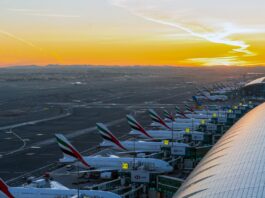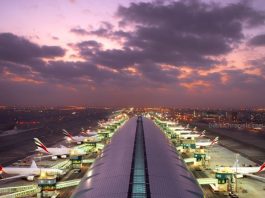

Dubai International processed 31.5 million passengers in the first half of 2026, a 31.3 percent decline against the same period last year. Regional airspace constraints tied to the conflict in the Middle East drove the drop, reshaping capacity across the network during what Dubai Airports has described as one of the most difficult operating periods in the airport’s history.
The trajectory inside that total tells a different story than the headline number. Monthly traffic built steadily through the second quarter, rising from 3.5 million guests in April to 4.5 million in May and 5 million in June. Aircraft movements reached 150,600 for the half, with 62,500 of those in Q2 alone, down 32.1 percent year on year. Load factors continued to strengthen as international carriers restored routes, closing in on 2025 levels by the end of June.
By the close of H1, DXB connected guests to 217 destinations across 99 countries through almost 50 international airlines. Cargo volumes reached 751,340 tonnes for the half, including 351,716 tonnes in Q2, down 28.7 percent year on year. The airport processed 30.3 million bags over the same period, a 28 percent decline, with a mishandled baggage rate of 2.7 per 1,000 passengers, well under the global industry benchmark of roughly 4.9.
Passenger flow metrics held firm despite the volume swings. Departure passport control cleared 98.98 percent of guests in under 10 minutes. Arrival passport control cleared 98.95 percent in under 15 minutes. Security processed 99.34 percent of passengers in under five minutes.
The decline sits apart from the broader aviation picture. Global passenger demand stayed close to flat across the same six months, with the softness concentrated in Middle East routes specifically rather than spread across the industry, and long range forecasts from Google, Deloitte, and aviation bodies continue to project sustained growth in global travel through 2040 and beyond. DXB’s H1 reads as a regional event inside a market that kept expanding around it.
Dubai Airports is using the recovery window to accelerate infrastructure work rather than wait for volumes to fully normalize. Plans include a consolidated remote departures experience, expanded self-service processing, continued rollout of biometric systems, and redesigned guest areas intended to improve flow through the terminal and comfort in waiting zones. The operator frames this as preparation for the airport’s traditionally busier second half, when winter scheduling, easing travel advisories in key source markets, and a full calendar of business and sporting events typically lift transfer traffic.
The scale of the H1 decline puts real weight on H2 execution. Whether the airport closes 2026 near prior year totals depends on how quickly airline networks rebuild frequency and how fast international transfer traffic, historically DXB’s core strength, returns to its share of total volume.