








Something is changing in how luxury moves through a room.
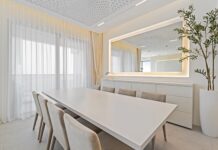
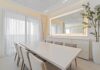
For most of the last decade, the dominant language of high-end interiors in Dubai and across the Gulf has been restraint. Honed stone. Walnut. Bronze. Surfaces that recede so the architecture can speak. That direction has produced beautiful spaces, and it has also produced a generation of interiors that, seen in sequence, begin to resemble each other.
Two announcements suggest the next chapter is being written, and it is being written in Italian.
RAK Ceramics, founded in Ras Al Khaimah in 1989 and now one of the world’s largest ceramic manufacturers by output, has signed an exclusive multiyear licensing agreement with Roberto Cavalli for the development, manufacture and distribution of Roberto Cavalli branded ceramic tiles, sanitary ware and faucets across twelve territories including the UAE, Saudi Arabia, Egypt, Turkey and India. The first collections will be unveiled at Cersaie 2026 in Bologna in September, the world’s definitive exhibition for ceramic surfaces and bathroom furnishings. Selected RAK Ceramics flagship showrooms in the UAE will host an exclusive preview before that, and Dubai Design Week in November will follow with a dedicated showcase. No images have been released yet. That absence is the most interesting thing about the announcement.
Roberto Cavalli’s design language has always been built around animalia, complex surface pattern, and a specifically Italian understanding of excess as a form of sophistication rather than a lapse in taste. His work in fashion, built on printed silk jersey, hand-painted leather and a palette drawn from the wild rather than from the neutral card, operated on the principle that a surface handled with enough conviction becomes its own argument. The question the RAK Ceramics collaboration will answer in September is what happens when that conviction is applied to a material that does not move, does not drape, and does not leave the room at the end of the season. Ceramic is permanent. A tile is a commitment.
The Cavalli aesthetic sits at a deliberate distance from the warm minimalism that has defined Gulf interiors for the past five years. It does not resolve quietly into a background. It asks to be looked at. For a collector who has already answered the warm minimalism question in their main living spaces and is now asking what comes after restraint, that directness is exactly the right provocation. The wall and the floor as canvas rather than background is a tradition with deep Italian roots, from the majolica workshops of Faenza to the decorative surface programs of Vietri sul Mare, and RAK Ceramics has the manufacturing infrastructure to bring that tradition to a scale the Gulf market has never seen applied to a single design language before.
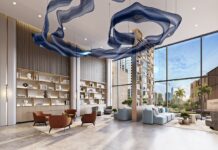
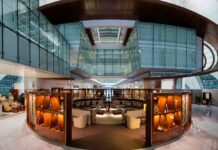
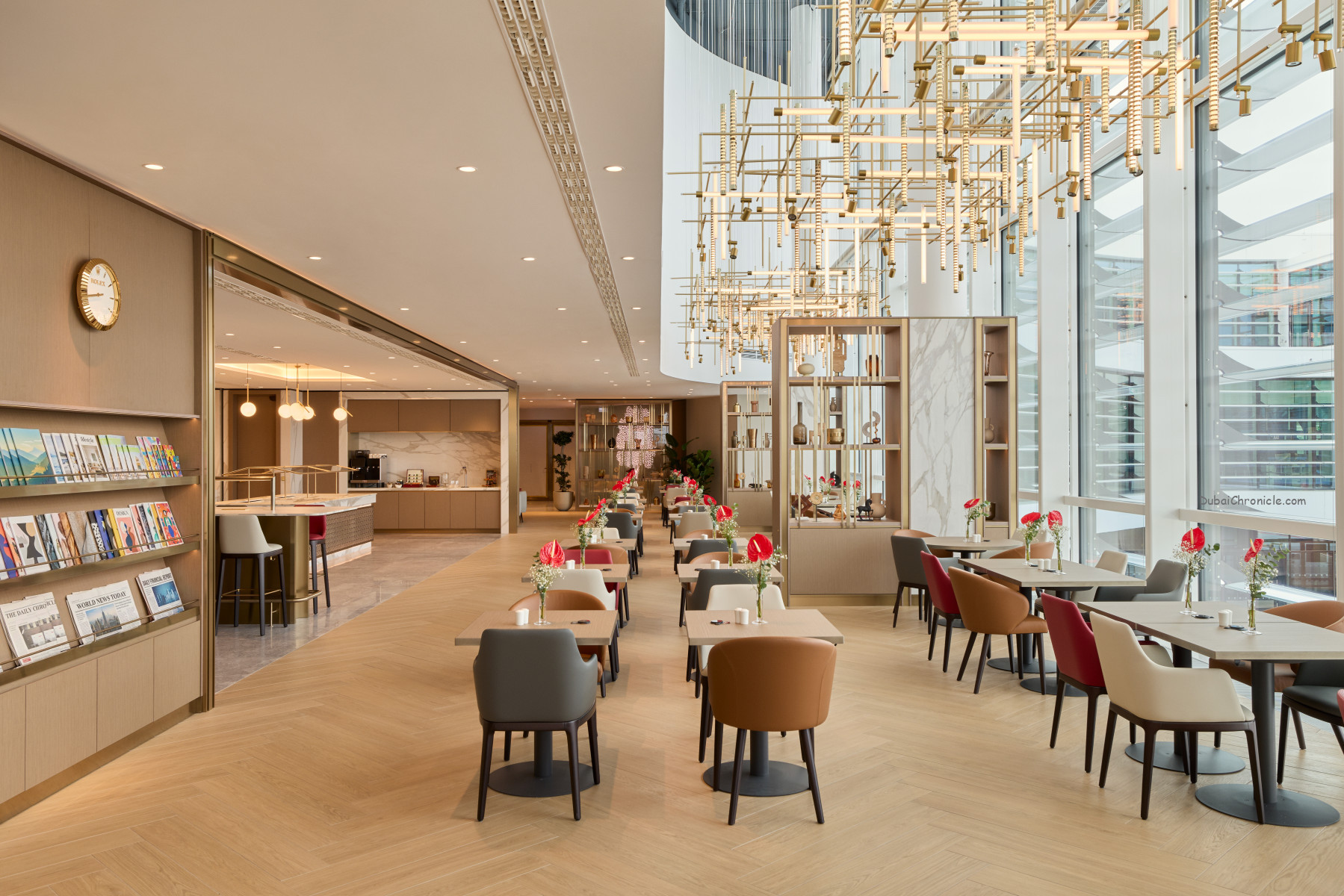
 Emirates has launched its next-generation lounge concept with the same cultural address, though the Italian thread runs differently here. The new signature lounges, now open in Munich and Frankfurt and rolling out to Manchester, Mauritius and Istanbul through the end of the year, carry an investment of more than AED 50 million per location. The seating is upholstered in Italian eco-leather. The dining program introduces a dedicated bread oven producing handcrafted pizzas and flatbreads alongside manakeesh, a Levantine bread embedded in the daily food culture of the UAE, and a barista bar with an in-house mixologist. The food and material choices trace the same arc: Italian craft applied to a Gulf sensibility, in a space designed to be occupied rather than passed through.
The wider material palette of the Emirates lounge reinforces this reading. Herringbone floors run throughout, a pattern with a long history in European residential interiors, traditionally laid in oak or walnut, here appearing in a transit environment as a signal that the design team was thinking about the floor the way a residential interior designer would rather than the way a contract fit-out team would. Marble and gold appear as accents. Lighting is discreetly integrated. The cultural anchor is the backlit Ghaf Tree motif, a reference to the UAE national tree, native to the Arabian Peninsula and one of the few species that survives desert conditions without irrigation, rendered in light at the centre of each new lounge. The shower suites carry VOYA amenities, an Irish brand founded in 2006 around hand-harvested Atlantic seaweed from County Sligo, chosen for what it is made of rather than for how widely it is recognised. The Rolex clocks on the walls display global time zones. Each of these is an object selected on the basis of provenance and construction quality, not category recognition.

Both announcements are making the same argument from different starting points. The Emirates lounge is saying that a transit space should read like a considered room, with Italian craft at the seating, European residential logic in the floor, and cultural provenance built into the detail rather than applied as decoration. The RAK Ceramics agreement is saying that the next move in Gulf interior design is toward surface as statement, toward the kind of Italian craft tradition that treats pattern and colour as architectural decisions rather than finishing choices.
The collector who is paying attention to both will be in a RAK Ceramics showroom in the UAE before September, and in Bologna in the same month, and at Dubai Design Week in November. Not because they need new tiles. Because they want to know what the surface looks like when Roberto Cavalli makes a permanent decision. That answer arrives in four months.