




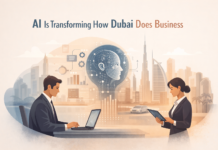










AI in Dubai is no longer a future trend or a strategic talking point. It is actively transforming how Dubai does business, reshaping operations, decision-making, and customer experience across industries.
What makes this shift significant is not just the technology itself, but the speed at which it is being adopted. In a market known for rapid growth and competition, AI is quickly becoming a dividing line between companies that are scaling efficiently and those struggling to keep pace.
This transformation is closely aligned with the UAE’s broader ambitions. The country has committed to becoming a global leader in artificial intelligence through long-term initiatives such as the UAE National AI Strategy 2031. At the same time, Dubai is accelerating its digital transformation by moving toward a unified platform that consolidates government services, simplifying access for businesses and enabling more integrated data use.
Together, these efforts are creating an environment where AI is not just supported but expected.
How AI in Dubai Is Transforming Business Operations
Across key sectors, AI is already delivering measurable results.
Real Estate
Dubai’s real estate sector has been one of the fastest to integrate AI into core operations.
AI-powered valuation tools now analyze market data in real time, helping agencies price properties more accurately. Lead qualification systems filter inquiries and identify serious buyers, allowing sales teams to focus their efforts more effectively.
The impact is tangible. Agencies that have adopted AI are reporting up to 30% lower customer acquisition costs and significantly faster deal cycles. In a market where timing and margins are critical, these efficiencies provide a clear competitive advantage.
Financial Services
Within the Dubai International Financial Centre, AI is reshaping financial operations at scale.
Machine learning models are being used for compliance monitoring, fraud detection, and portfolio analysis. Processes that once required manual oversight are now automated, faster, and more accurate.
The Dubai Financial Services Authority has supported this evolution through its regulatory sandbox, allowing firms to experiment with AI solutions in a controlled environment.
Industry estimates suggest that AI-driven systems can reduce compliance costs by up to 40%, while improving risk detection and operational efficiency.
Retail and Hospitality
AI in Dubai is also reshaping how hotels and retailers identify, target, and convert customers. In hospitality, the focus is shifting toward precision targeting rather than broad marketing.
Hotels are increasingly using AI to analyze browsing behavior, booking patterns, and loyalty program data to identify high-value travelers. By combining this data with scaled digital campaigns, particularly through Meta platforms, they can reach the right audience with tailored offers before a booking decision is even made.
This approach allows hotels to move beyond generic promotions. Instead of competing on price alone, they are targeting specific traveler segments with personalized packages, timing offers based on intent signals, and increasing conversion rates while reducing wasted ad spend.
In retail, AI is being applied directly at the point of purchase. Algorithms track customer search behavior, both online and in-app, to surface relevant offers in real time. Shoppers are shown promotions aligned with what they are actively looking for, rather than broad, untargeted discounts.
This shift is changing how inventory is marketed and sold. Retailers are no longer pushing products. They are responding to demand signals as they happen.
As a result, personalization in Dubai is becoming more performance-driven. It is not just about improving the customer experience. It is about increasing conversion, optimizing marketing spend, and driving measurable revenue growth.
The Implementation Gap in AI Adoption
Despite strong momentum, not all businesses are adopting AI at the same pace.
Many SMEs and mid-sized companies in the UAE remain in the early stages. They understand the importance of AI but have not yet integrated it into their operations.
The barriers are practical:
- Limited access to skilled AI talent
- Challenges integrating AI with existing systems
- Uncertainty about where to begin
Recent estimates indicate that while over 70% of businesses in the UAE recognize AI’s importance, fewer than 35% have implemented it at scale.
This gap is becoming a competitive issue. Companies that delay adoption risk losing ground to competitors that are already operating more efficiently.
At the same time, it is creating opportunities. Dubai has seen rapid growth in AI startups, consultants, and technology providers offering solutions designed to help businesses transition from awareness to execution.
Dubai’s Digital Push Is Accelerating AI Adoption
One of the most important developments shaping AI in Dubai is the government’s move toward unifying digital services.
Dubai is working to bring all government services into a single, integrated platform. This initiative is designed to simplify processes, reduce friction, and create a more connected data ecosystem.
For businesses, this has direct implications.
A unified platform means easier access to services, faster approvals, and better integration with digital tools. More importantly, it creates the data infrastructure needed for AI systems to operate effectively.
This is a key advantage. AI does not function in isolation. It depends on data, connectivity, and seamless systems — all areas where Dubai is investing heavily.
Why Dubai Has a Competitive Edge in AI
Dubai’s approach to AI stands out for its speed and flexibility.
Regulators in the UAE have consistently taken a proactive stance, creating frameworks that enable innovation rather than restrict it. This is evident in areas such as generative AI, data governance, and emerging technologies.
For businesses, this translates into a more supportive environment for experimentation and implementation.
It also explains why an increasing number of global companies are choosing Dubai as their regional base.
The combination of infrastructure, regulation, and market access makes it an attractive location for AI-driven operations.
What Comes Next
The next phase of AI in Dubai will be defined by execution.
As tools become more accessible and cost-effective, adoption will accelerate across businesses of all sizes.
The focus will shift from understanding AI to using it effectively.
For SMEs, this means starting with practical applications such as automation and customer insights.
For larger organizations, the challenge is scaling AI across operations to create long-term competitive advantage.
Dubai has already built the foundation. The strategy is clear, the infrastructure is in place, and the ecosystem is expanding.
What matters now is how businesses respond.
Because in Dubai today, AI is not just transforming industries.
It is transforming how business itself is done.