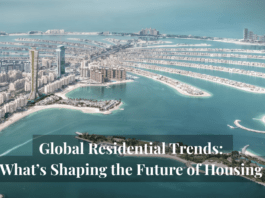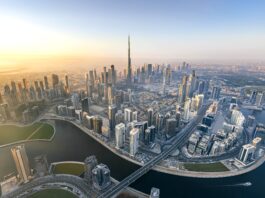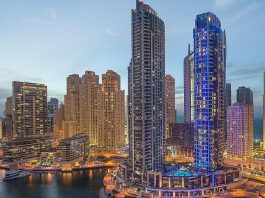

As 2025 came to a close, the UAE property market demonstrated resilience, stability, and a clear shift toward maturity. According to the latest UAE Residential Property Price Report for December 2025, the market ended the year with continued growth in both prices and rents across most emirates, albeit at a more measured pace compared to the rapid acceleration seen in earlier years.
December’s data confirms that the UAE property market is no longer driven by short-term momentum alone. Instead, it is increasingly supported by strong fundamentals, including population growth, sustained rental demand, lifestyle migration, and long-term capital inflows.
UAE Property Market Prices: Steady Growth Into Year End
Residential property prices continued to rise in December, reinforcing investor confidence as the market moves into 2026.
| City | Monthly Change (Dec 2025) | Year-on-Year Change |
|---|---|---|
| Abu Dhabi | +2.61% | +31.59% |
| Dubai | +0.66% | +12.88% |
In Abu Dhabi, residential prices recorded a 2.61 per cent month-on-month increase, closing the year with a robust 31.59 per cent annual growth. This performance reflects sustained demand for quality housing combined with a relatively limited new supply pipeline.
Dubai, while showing more moderate monthly growth of 0.66 per cent, maintained a solid 12.88 per cent year-on-year increase. Rather than signalling a slowdown, this points to a stabilising Dubai property market—an encouraging sign for long-term investors and end users.
Apartment Segment Leads the UAE Property Market
Apartments once again emerged as the strongest-performing residential asset class within the UAE property market at year end.
| City | Monthly Change (Dec 2025) | Year-on-Year Change |
|---|---|---|
| Abu Dhabi | +2.78% | +34.77% |
| Dubai | +0.75% | +12.52% |
| Ras Al Khaimah | +0.80% | +65.72% |
| Ajman | +2.85% | +9.03% |
| Sharjah | +0.74% | -5.66% |
In Abu Dhabi, apartment prices rose 2.78 per cent in December, reaching an impressive 34.77 per cent annual increase. Dubai apartments also continued their steady upward trajectory, with a 0.75 per cent monthly rise and 12.52 per cent annual growth, underlining consistent tenant and end-user demand.
Ras Al Khaimah stood out as the fastest-growing market in 2025, with apartment prices surging 65.72 per cent year-on-year. This reflects the emirate’s growing appeal as a lifestyle and tourism-led investment destination.
- Read more: UAE Real Estate: One Emirate Skyrocketing Off-Plan Prices Defy Fundamentals
Meanwhile, Ajman apartments recorded moderate annual growth of 9.03 per cent, while Sharjah saw a 5.66 per cent year-on-year decline, highlighting the increasing importance of location quality and demand drivers within the broader UAE property market.
Rental Market Strength Supports UAE Property Market Valuations
Rental performance remained a key pillar supporting residential valuations throughout 2025.
| City | Annual Rental Growth |
|---|---|
| Abu Dhabi | +23.58% |
| Ras Al Khaimah | +24.65% |
| Dubai | +7.04% |
| Ajman | +6.75% |
| Sharjah | +8.47% |
Apartment rents continued to rise across the UAE in December. Abu Dhabi recorded annual apartment rental growth of 23.58 per cent, while Ras Al Khaimah followed closely at 24.65 per cent. Dubai apartment rents increased 7.04 per cent year-on-year, reflecting a more mature rental market with high occupancy levels.
| City | Gross Yield (Approx.) |
|---|---|
| Ras Al Khaimah | ~7.03% |
| Abu Dhabi | ~6.78% |
| Dubai | ~5.66% |
Gross rental yields at year end reinforced the appeal of apartments for income-focused investors. Apartment yields stood at approximately 6.78 per cent in Abu Dhabi, 5.66 per cent in Dubai, and 7.03 per cent in Ras Al Khaimah, remaining competitive by international standards.
Villas in the UAE Property Market: Capital Preservation Over Yield
Villa markets across the UAE ended 2025 with stable price appreciation but more subdued rental growth.
| City | Monthly Change (Dec 2025) | Year-on-Year Change |
|---|---|---|
| Abu Dhabi | +1.60% | +13.60% |
| Dubai | +0.10% | +15.16% |
In Dubai, villa prices rose 15.16 per cent year-on-year, although monthly growth in December was minimal. Abu Dhabi villas recorded 13.60 per cent annual growth, supported by family-driven demand and limited availability in established communities.
Rental trends for villas were more mixed. While Abu Dhabi villa rents increased 11.32 per cent annually, Dubai villa rents saw only marginal annual growth of 1.20 per cent. This divergence highlights the role of villas primarily as lifestyle and capital-preservation assets rather than yield-maximising investments.
| City | Annual Rental Growth |
|---|---|
| Abu Dhabi | +11.32% |
| Dubai | +1.20% |
Market Balance and Price-to-Rent Ratios
Price-to-rent ratios across the UAE property market remained within healthy ranges at year end, signalling a balanced environment.
| City | Apartments (Years) | Villas (Years) |
|---|---|---|
| Abu Dhabi | ~15.20 | ~21.17 |
| Dubai | ~18.12 | ~22.05 |
In Dubai, apartment price-to-rent ratios stood at approximately 18.12 years, while villas reached around 22.05 years. Abu Dhabi recorded lower ratios of 15.20 years for apartments and 21.17 years for villas, suggesting comparatively stronger rental fundamentals.
These indicators confirm that price growth remains closely linked to income performance rather than speculative excess.
What December 2025 Reveals About the UAE Property Market in 2026
The December figures confirm that the UAE property market enters 2026 from a position of strength. Growth is continuing, but with greater selectivity and discipline. Apartments remain the preferred asset class for investors seeking liquidity and rental income, while villas continue to appeal to end users and long-term capital holders.
Dubai’s market maturity, Abu Dhabi’s sustained momentum, and Ras Al Khaimah’s rapid transformation together present a diversified and resilient property landscape.
As the UAE property market moves forward, success will increasingly depend on asset quality, location, and long-term fundamentals rather than timing alone. The close of 2025 marks not the end of growth, but the beginning of a more measured and sustainable phase for UAE real estate.