













The International Monetary Fund (IMF) has trimmed its global economic growth forecast to 3.2% in 2025 (down from 3.3% in 2024), with a further slowdown to 3.1% anticipated in 2026. At the heart of this revision: rising global fragmentation, surging protectionism—especially from the U.S.—and mounting debt risks. The forecast signals a cautious period ahead for global markets, with Emerging Market Economies (EMEs) expected to feel the pinch, growing at a slower 4.2% in 2025 and 4.0% in 2026.
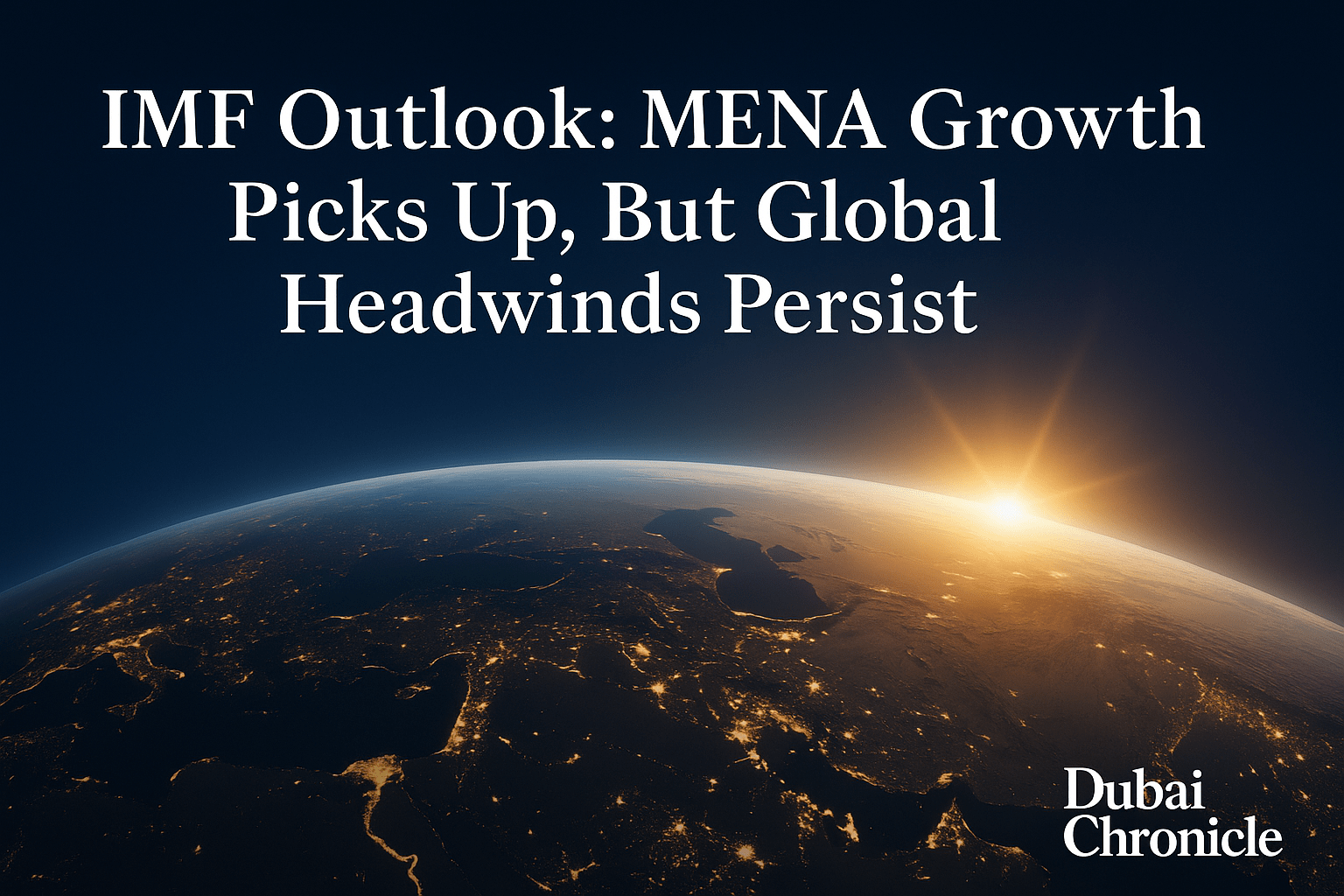
Yet, amid the global slowdown, the MENA region—particularly the UAE and Dubai—is set to outperform.
MENA Region: Growth on a Rebound
The IMF projects MENA’s growth to rebound to 3.3% in 2025 and further to 3.7% in 2026, largely due to easing oil production cuts, fewer disruptions to supply chains, and the resilience of non-oil sectors in GCC economies. Inflation is also projected to ease across oil-importing nations, thanks to lower energy costs and tighter monetary policies.
Despite only moderate direct exposure to U.S. tariff hikes, the region still faces indirect risks from weaker global demand and softer commodity prices. Nonetheless, strong fundamentals across GCC states, especially in non-oil diversification, infrastructure investment, and trade, are expected to anchor regional stability.
UAE: Leading from the Front
The UAE is forecast to grow by 4.8% this year and 5.0% in 2026, one of the highest rates among MENA economies. Its diversification strategy continues to yield results, with trade, travel, and finance providing solid buffers against external shocks.
Foreign trade data from 2024 showed a robust AED 293.7bn current account surplus. Goods exports and re-exports remained strong, while travel and transport services contributed significantly to the services surplus. With new anti-dumping measures in place to protect domestic industries, the UAE is moving to insulate itself from global pricing volatility—especially against the backdrop of cheap Chinese goods rerouted due to U.S. tariffs.
Sharjah is also pushing boundaries, nearing completion of its first yuan-denominated loan worth USD 400mn, while Mubadala is issuing new dirham bonds. Etihad Airways, meanwhile, continues to grow, flying 1.9mn passengers in September alone—a 21% jump year-on-year.
Dubai: Resilient, Diversified, and Forward-Looking
Dubai remains a beacon of economic diversity within the region. Its focus on innovation, entrepreneurship, and global connectivity gives it a distinct edge. Intra-GCC trade, which hit USD 1.5trn in 2024, positions Dubai—and the UAE more broadly—as critical nodes in global supply chains.
The emirate’s long-standing efforts in regulatory reform, smart infrastructure, and talent attraction are paying off. Venture capital inflows to the region surged 152% year-on-year to USD 2.77bn in Jan–Sep 2025, with Dubai-based startups among the key beneficiaries.
Egypt, Saudi Arabia, and the Broader Region
In Egypt, exports surged 17.3% year-on-year in the first seven months of 2025. The country is pushing hard to comply with IMF-backed reforms: fuel prices were hiked again, a new IPO pipeline was submitted, and fiscal restructuring is in motion. Egypt also saw strong tourism numbers—15 million visitors in Jan–Sep—and is ramping up upstream energy investments.
Saudi Arabia, meanwhile, is maintaining momentum across multiple fronts. Growth is forecast at 4.0% in both 2025 and 2026. Inflation has eased to 2.2% in September, and commercial activity is booming, with over 1.7 million business registrations by Q3 2025. Sovereign debt is rising—but deliberately—as part of strategic investments in productivity, housing, and industrial development. Notably, industrial rents in Riyadh spiked by 16% in H1 2025, driven by surging demand for logistics and cold storage.
Saudi Arabia’s free zones aim to attract SAR 100bn (USD 26.7bn) in investment, offering tax and duty exemptions to lure businesses. Meanwhile, Aramco’s long-term outlook on oil and gas reinforces its dominance, even as energy transition narratives evolve globally.
Key Risks and Global Spillovers
Despite regional optimism, the global outlook remains clouded. A potential debt crisis is brewing in the U.S., with First Brands filing for bankruptcy and raising red flags about the shadow banking sector. The IMF has expressed concern about the blurred lines between traditional banks and non-bank financial players—risks that could ripple across global markets, including MENA.
Moreover, the lack of U.S. economic data due to government shutdowns is feeding uncertainty. Inflation figures, due shortly before the next Fed meeting, could further influence global monetary policy, investment flows, and commodity prices—all with downstream effects on the region.
While the global economy is entering a slower-growth phase, the MENA region—especially the UAE and Dubai—is charting a different course. Backed by resilient non-oil sectors, strategic trade positioning, and forward-thinking policies, the region is not just weathering global headwinds but turning them into opportunities.
The key will be staying agile: managing inflation, navigating geopolitical tensions, and pushing ahead with reform and diversification. If that continues, MENA may well outshine broader EMEs in the years ahead.