




Frontier Markets ETFs Soared in May
June 2, 2013 by Editor · Leave a Comment
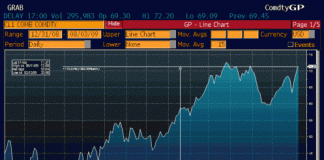
The iShares MSCI Frontier 100 ETF is proving Thursday’s massive volume spike was not a fluke. Along with some other frontier markets ETFs , FM touched a new high yesterday on stunning volume. In the case of FM, the ETF traded more than 30 times its trailing 90-day average turnover. FM has “slowed down” a bit Friday to trade nearly quadruple its daily average. Read more
Fund Manager Survey finds investors less positive
April 17, 2013 by Editor · Leave a Comment
Global investors are moderating their earlier exuberance in the face of somewhat lower conviction over global growth, though they remain positive towards equity markets overall, according to the BofA Merrill Lynch Fund Manager Survey for April.
UAE Equity Markets Advance on Foreign Investments Comeback
April 9, 2013 by Editor · Leave a Comment
The UAE equity markets have been shown interesting activities recently. The prior market expectations were quite bearish. Projections pointed to a corrective index wave that could place equities to the 1700-1750 area. However the UAE market performed otherwise which lead in the direction of more upside local equities.
In late March the market faced corrective wave. Though the recent days, equities shifted their direction into a rally. The major factor for the bull recovery is the return in foreign buying activity. All the previous equities rallies were fanned by foreign influx. Therefore the scale of the influx is crucial for the UAE market trend determination.
Since 2008 the foreign investment is the major driver which triggers all the bull and bear trends on the market. The disregard of this foreign tendency proved to lead only to poor investments and lost opportunities.
There is not reliable explanation why foreigners returning into the UAE market. Moreover the world events suggest a risk-off mode on track. One of the possible reason is believed to be a season earning strategy.
In the upcoming days UAE will announce the Q1 financial results and it very likely to witness more foreign purchase before the report.
There is an important statistic which should be taken into account. The recent rally has been conducted by small-scale stocks. This could arrange the setting for an overtake move by the large equities. Something similar has been witnessed at the beginning of the 2013.
However it is a very hard task to determine how far the rally could go. Though, as long as the foreign investors remain net buyers the UAE equities will thrive.
The emerging independent financial network in the Emirates has a strong and influential presence. And that is namely among the foreign investor community. Gulf-based financial advisors are also adding to a setting of increasing risk tolerance. Therefore advisors are capable of pouring more investment into the equity product from the Emirates.
The flow of foreign capital to the Gulf Region could slow over time. However economically attractive centers like UAE, Qatar and Saudi Arabia are expected to maintain their attractiveness. These countries remain the most popular investment venues and are all poised to experience consistent growth during this year.
GCC Markets Performance in March 2013
April 7, 2013 by Editor · Leave a Comment
· All GCC markets, except the UAE, ended in the green
· Kuwait led the rally, with a 4.0%MoM gain, followed by Saudi Arabia
· Trading activity increased on MoM basis
· IPO activity remained subdued
GCC markets on a rise – UAE backtracks
GCC equity performance remained mixed in March. All bourses, except ADX and Dubai, gained during the month. The KSE index experienced the highest growth of 4.0%MoM amongst GCC markets. Saudi Arabia’s Tadawul index, the second best performer, rose 1.8%MoM. Dubai was the worst performer (down 5.1%MoM) amongst GCC markets, Oman and Bahrain experienced a marginal growth of 0.6%MoM, 0.2%MoM and 0.2%MoM, respectively, in March.
2013 Offers Better Prospects for UAE, Saudi Arabia’s Financial Markets
December 30, 2012 by Editor · Leave a Comment
At present, market analysts expect that in the first half o 2013, stock markets of UAE and Saudi Arabia will excel in performance compared to the financial markets in other Middle Eastern countries. These expectations are based on the steady economic growth combined with the strategic asset management and optimistic economic forecasts.
Private capital pursuing mining and metals investments
December 18, 2012 by Editor · Leave a Comment
Increasing interest in mining and metals from private equity funds, sovereign wealth funds and state-owned enterprises is set to be a key trend in the sector in 2013, according to Lee Downham, Ernst & Young’s Global Mining & Metals Transactions Leader. Read more
Equity markets in emerging economies to experience significant growth in next decade
December 18, 2012 by Editor · Leave a Comment
Emerging market capitalization could account for half of the world total by 2020
In under a decade, equity markets in the emerging world have flourished and become critical sources of finance for emerging markets (EM) businesses according to Ernst & Young’s Moving towards the mainstream report, produced in collaboration with the Ernst &Young /SKOLKOVO Institute for Emerging Markets Studies. Read more
Optimism outweighs fears of Fiscal Cliff
November 14, 2012 by Editor · Leave a Comment
Signs That Great Rotation out of Bonds Into Equities Is Starting
Confidence in the outlook for China’s economy has surged to a three-year high, underpinning broader optimism about the global economy and equity markets, Read more
Leading Dubai-based conglomerate to launch an IPO
September 5, 2012 by Editor · Leave a Comment
Dubai-based conglomerate Al Habtoor Group is considering to launch an IPO (initial public offering) in Dubai given strengthening equity markets, the company said in a statement on Wednesday.
A flotation by a family-owned giant like Habtoor would potentially help Middle Eastern equity markets recover from the aftermath of the global financial crisis, which severely dampened investor appetite for regional offerings and forced some companies to shelve listing plans. Read more
Correlation between UAE’s and global equity markets remains positive
June 17, 2012 by Editor · Leave a Comment
Average correlation of Abu Dhabi and Dubai markets with the global markets remains positive during the years of a financial downturn.
The UAE equity markets have been affected by the stock market crash in the U.S. equity markets and by the burst of the domestic real estate bubble. A number of studies have found that individual GCC markets demonstrated strong cross effects from global markets.
Valuations in the Abu Dhabi and Dubai equity markets have not recovered since September 2008, notwithstanding some improvement in 2009.
The combined market capitalization losses in the Abu Dhabi and Dubai stock exchanges were $102 billion between September 1, 2008 and March 31, 2012, according to the IMF. The capitalization loss in the Dubai stock exchange was approximately $59 billion.
Volatility in the stock markets increased after September 2008. The average correlation of the Abu Dhabi and Dubai markets with the global markets turned positive in the period after September 2008, as compared to a negative correlation during the period between January 1, 2007 and September 9, 2008.
Market volatility increased after the crisis, but seemed to have settled down since the beginning of 2011.
At present, the near term perspective seems greemy with a traditionally slow summer season approaching. Shares at both UAE markets trade mixed, with no clear direction seen among the industry sectors. Trading volumes remained thin.
UAE Minister of Economy Sultan Bin Saeed Al-Mansouri said recently that he expects the UAE’s real GDP growth to decrease to 3 percent in 2012, down from 4.2 percent in 2011.
Index provider MSCI will decide in June whether or not it will upgrade the UAE to the status of an emerging market from the current level frontier market. But due to the very negative performance in May, traders on the DFM’s trading floor doubt that the UAE will see an upgrade.
The sluggish performance on the DFM since May is simply related to events globally and Greece and Euro zone troubles in particular. Most regional markets have been correlated with global equity markets and external factors.